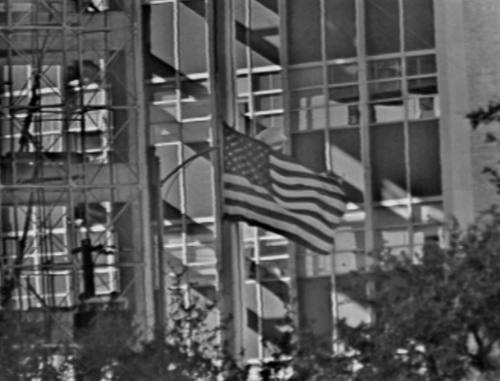
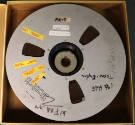
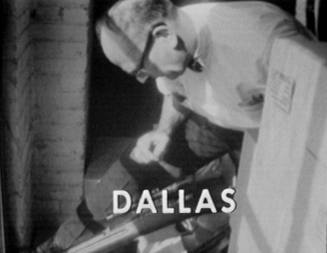
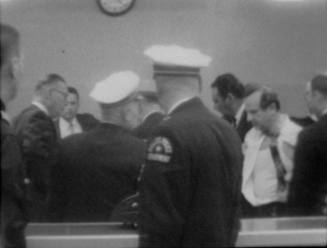
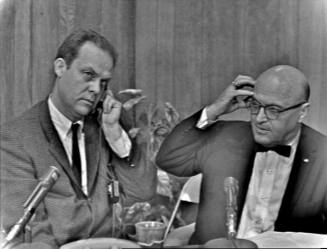
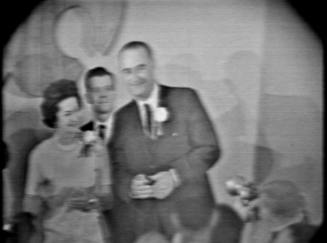
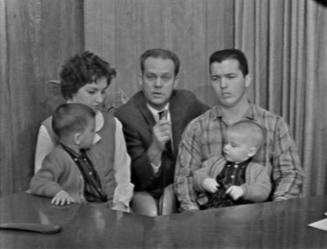
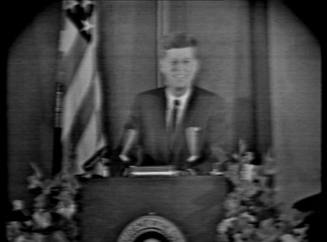
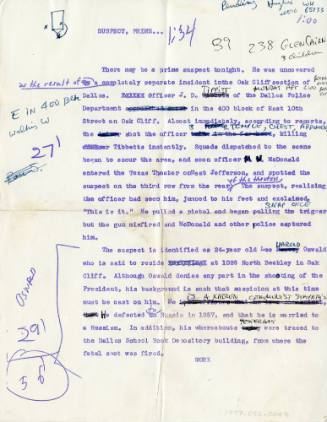
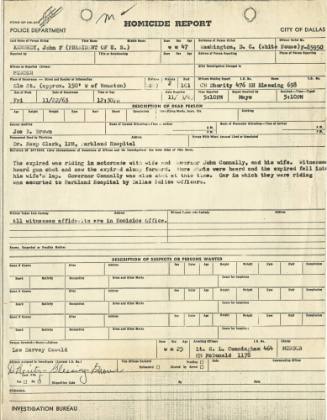
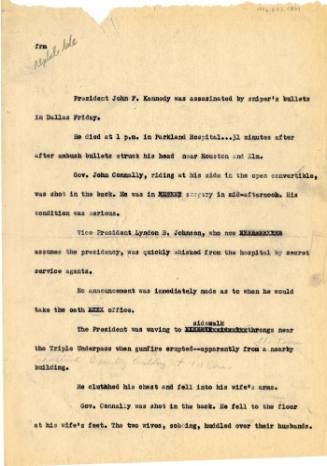
Description2" video reel with original black and white coverage by Dallas ABC affiliate WFAA-TV. The reel contains news footage and coverage from Dallas, Texas following the assassination of President John F. Kennedy on November 22, 1963. Coverage begins with WFAA-TV broadcaster Ed Hogan reporting from inside Parkland Memorial Hospital where President Kennedy and Governor John Connally were taken for treatment. Governor Connally’s press aide, Julian Read, provides updates on the Governor’s condition from a temporary press office set up inside a nurses' classroom. He reports that the Governor is finishing up four hours of surgery to treat a bullet wound that entered through his back, travelled through his body causing several shattered ribs, coming out through his frontside, grazing his wrist causing a fracture and finally embedding into his thigh. The Governor’s wife, Nellie Connally, along with his mother, siblings and eldest son are at Parkland Hospital, while his wo youngest children remain in Austin, Texas. The operating surgeon, Dr. Robert Shaw, would like him to stay in the hospital between ten and fourteen days for examination. Coverage transitions to footage from outside of Parkland Hospital featuring the grounds, a flag at half staff, crowds, and police officers arriving at the scene. Members of the press are seen boarding a large bus. Ed Hogan returns, narrating the scenes from outside the hospital, noting the flag at half staff and the reporters boarding the bus. Hogan emphasizes the current state of shock in Dallas. The footage then focuses on Ed Hogan interviewing people standing outside of the hospital. He interviews several people who are upset by the assassination and believe that Dallas may not be the same after today. Footage transitions to November 23, 1963, in a hallway at Dallas police headquarters where CBS journalist Dan Rather stands ready to report. Coverage shifts to ABC reporter Paul Good standing outside of the Dallas City Hall at night. He reports that suspect Lee Harvey Oswald is currently held in a cell inside and has been interrogated several times. He notes that Oswald maintains his innocence and Dallas Police see no signs of imminent confession. Paul Good reports that the rifle suspected to be used in the assassination was purchased for $12.78. Police have said they have photographic evidence that the pistol and rifle may have belonged to Oswald, based on a photograph of Oswald with the weapons. According to Good, the evidence gathered by the Dallas Police Department suggests that Lee Harvey Oswald was the assassin. Good notes that Oswald will be moved the next day from the city jail to the Dallas County Jail. Finally, it is reported that Oswald would like a lawyer from New York to represent him, and if that cannot happen, he will request the Civil Liberties Union for representation.
Footage was recorded in Dallas, Texas on November 22 and 23, 1963. The tape is approximately thirty-two minutes long.
Curatorial Commentary
In 1963, a major news event like a presidential visit generated a significant amount of local coverage by newspaper, radio and television outlets. Large locally-broadcast events during President Kennedy's trip to Texas, such as the Fort Worth Chamber of Commerce breakfast and the arrival of the Kennedys at Dallas Love Field, were often managed by cooperative pool coverage among local TV stations. In those instances, one outlet--such as ABC affiliate WFAA-TV at Love Field and CBS affiliate KRLD-TV at the Dallas Trade Mart luncheon--set up cameras to capture a pool feed that would be distributed to other local television stations for broadcast. This allowed for immediate coverage of an evolving news story in a practical and efficient manner, considering the transportation and setup logistics for bulky equipment and mobile news cruisers. - Stephen Fagin, Curator
The late Julian Read, who passed away in 2021 at the age of 93, was a longtime friend of The Sixth Floor Museum at Dealey Plaza. In addition to two oral histories, recorded in 2003 and 2013, he participated in three public programs recorded between 2013 and 2016. His first program, a lecture based on his 2013 memoir, may be found here on the Museum's YouTube channel: JFK's Final Hours In Texas.
A 2014 Living History program may be viewed here: Living History with Julian Read. - Stephen Fagin, Curator
When she is briefly interviewed outside of Parkland Memorial Hospital by WFAA-TV broadcaster Ed Hogan, Mrs. Quincy (Suzanne) Adams is seen holding an 8mm home movie camera. Although the original film was lost by the time the Museum identified Adams in 2007, she still had a VHS copy of the footage she captured outside of the hospital on November 22, 1963. She graciously donated the VHS tape to The Sixth Floor Museum. Her footage was featured in a compilation of home movies, narrated by the late Museum Curator Gary Mack, screened as part of a public program on October 12, 2012. Adams' film may be seen at the 19:27 mark in this recording: "Meet the Museum: Spotlight on Home Movies" Program – Works – The Sixth Floor Museum at Dealey Plaza. - Stephen Fagin, Curator
The last four minutes of this WFAA-TV tape, comprised of the nighttime report by ABC reporter Paul Good outside of Dallas police headquarters on November 23, 1963, also appears in a slightly truncated version at the end of WFAA-TV Pres. Kennedy Master PK-8 (1998.010.0008). While PK-8 cuts off the last twenty seconds of Good's report, it appears here on PK-7 in full. After Good says that the assassination brought "grief and anguish and uncertainty to millions of Americans," missing from the version on PK-8 are the words: "...in some perverted cause. Whatever the cause, he smirks today as he goes through the police corridors in this building. This is Paul Good, returning you to the studios WFAA." - Stephen Fagin, Curator
At the time of the Kennedy assassination in 1963, the WFAA Communications Center Studios was located at the corner of Young and Record Streets in downtown Dallas, approximately two blocks north of Dealey Plaza. As a result of their proximity, WFAA-TV/Channel 8 was the first local television station to break into programming with news of the shooting on November 22, 1963. Program director Jay Watson, himself an eyewitness to the assassination, interrupted the Julie Bennell Show, a local lifestyle and fashion program, approximately fifteen minutes after shots were fired in Dealey Plaza. In another first, Watson was the first to interview assassination eyewitnesses on the air after collecting the stunned Newman family in the plaza and rushing them to WFAA studios. The coverage that followed represents one of the most substantial archives of Kennedy assassination broadcast news footage in existence.
Amazingly, this historic news footage was nearly lost forever in the early 1980s. During that era, it was common for television stations to dispose of or recycle outdated broadcast tapes in order to save space and reduce costs. Prior to the age of widespread digital archiving, expensive videotapes were frequently erased and reused. Nearly twenty years after the assassination, a young WFAA-TV employee named John Sparks noticed all of the station's Kennedy tapes were boxed up and marked for disposal. Sparks, who had been part of the high school band that performed for President and Mrs. Kennedy in Fort Worth that fateful date, instantly recognized the historic significance of the material, and he singlehandedly rescued the tapes from destruction. The full WFAA-TV archive of Kennedy assassination news coverage was later donated to The Sixth Floor Museum at Dealey Plaza in 1998. Hear the inside story about how John Sparks saved this historic broadcast news footage in this 2025 Living History conversation: Living History from Fort Worth, November 22, 1963. - Stephen Fagin, Curator
Paul Good (1929-2005) was a radio, television and print journalist. After stints at the New York World Telegram and Sun and NBC, Good joined ABC News in 1960. He was briefly the Latin American bureau chief, stationed in Mexico City, before moving to Atlanta, Georgia, as the Southern bureau chief. There, he covered the Civil Rights Movement in states such as Mississippi, Alabama, Georgia and Florida. He left ABC News in 1964 and became a freelance writer. Good passed away on January 23, 2005. - Stephen Fagin, Curator
Multiple individuals seen on WFAA-TV tape PK-7 recorded oral histories with The Sixth Floor Museum at Dealey Plaza over the years. Among them are: